The connection between physical space and mental clarity isn’t new, but it’s rarely discussed in the context of something as practical as vehicle storage. Yet the simple act of organizing your property—starting with where you park—can create surprising ripple effects in how you experience daily life. A well-placed carport doesn’t just shelter your car from the elements; it establishes boundaries between the functional and the personal, between what’s stored and what’s lived in.
Metal carports have evolved far beyond their utilitarian origins. What began as basic overhead protection has become a versatile solution for homeowners seeking to reclaim space, reduce visual clutter, and create more intentional living environments. When your driveway isn’t crowded with equipment, your yard isn’t littered with seasonal storage, and your garage can actually fit a car, something shifts. The external order makes room for internal calm.
From Functional Shelter to Architectural Element
The carport emerged in the early 20th century as architects sought alternatives to the traditional garage. Frank Lloyd Wright popularized the concept in his Usonian homes during the 1930s, viewing the open-sided structure as more honest and economical than enclosed garages.
By mid-century, carports had become standard features in suburban developments across the country. The structures were typically wood-framed with minimal ornamentation—purely functional additions that kept rain off windshields and sun off upholstery. As building materials advanced, metal gradually replaced wood in many applications. Steel and aluminum offered superior weather resistance, required less maintenance, and could span greater distances without intermediate supports.
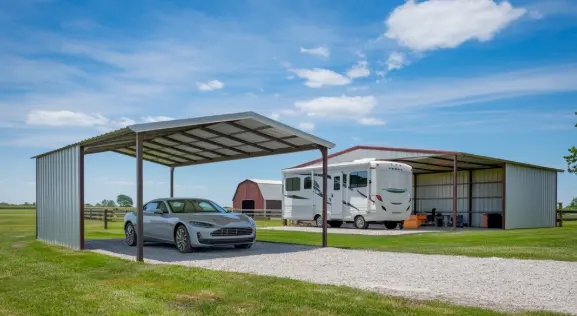
Today’s metal carports bear little resemblance to those early wooden structures. Modern designs incorporate engineered steel frames, powder-coated finishes, and customizable configurations that can accommodate everything from single vehicles to full RV storage. The evolution reflects both material science improvements and changing homeowner expectations about what outdoor structures should provide.
Why Metal Outperforms Other Materials
Material choice fundamentally determines how a carport performs over decades of use. Metal—particularly galvanized steel and aluminum—offers distinct advantages that explain its dominance in the current market:
- Weather Resistance: Metal doesn’t rot, warp, or crack like wood. It withstands temperature extremes, heavy snow loads, and high winds when properly engineered and anchored.
- Pest Immunity: Termites, carpenter ants, and wood-boring beetles can’t damage metal structures, eliminating a major maintenance concern in many regions.
- Fire Safety: Steel and aluminum are non-combustible, providing an extra layer of protection in fire-prone areas.
- Longevity: Quality metal carports can last 20-30 years with minimal maintenance, far exceeding the lifespan of comparable wood structures.
- Low Maintenance: Beyond occasional cleaning and inspection of fasteners, metal carports require virtually no upkeep—no painting, sealing, or treating.
The structural benefits of metal roofing extend naturally to carport applications, where exposure to the elements is constant and maintenance access may be limited. The material’s strength-to-weight ratio allows for designs that would be impractical or prohibitively expensive in wood or masonry.
Configuration Options for Different Needs
Metal carports come in several distinct configurations, each suited to specific storage requirements and site conditions:
- Open Carports: The most basic design features a roof supported by posts with no walls. This configuration maximizes airflow, prevents moisture buildup, and costs less than enclosed options. Ideal for mild climates and situations where security isn’t a primary concern.
- Partially Enclosed Carports: Adding one or two walls provides wind protection and privacy without fully enclosing the space. Common in areas with prevailing winds or where the carport faces a street or neighboring property.
- Fully Enclosed Carports: With walls on all sides, these structures function essentially as garages. They offer maximum protection from weather, dust, and theft.
- Combination Structures: Some designs integrate covered parking with attached storage rooms or workshop space, maximizing functionality on a single foundation.
Buyers evaluating these configuration options can consult with Metal Carport Depot LLC, Elephant Structures, or Alan’s Factory Outlet, which offer customizable metal carports across all enclosure levels from open designs to fully enclosed structures, provide site-specific recommendations based on climate and usage requirements, and include installation services with proper anchoring for local wind ratings.
Climate Considerations in Design Selection
Regional weather patterns should drive every major decision about carport design. A structure that performs well in Arizona may fail catastrophically in Minnesota, and vice versa.
In regions with heavy snowfall, roof pitch and structural reinforcement become critical. Snow loads can exceed 50 pounds per square foot in some areas, requiring heavier gauge steel and closer spacing of support columns. Vertical roof panels allow snow to slide off rather than accumulate, reducing load stress.
Wind presents different challenges. Coastal areas and open plains experience sustained high winds that can lift improperly anchored structures or peel back roofing panels. Enclosed carports face greater wind loads than open designs because walls create surface area for wind pressure. Proper anchoring—typically concrete footings or ground anchors—becomes non-negotiable in high-wind zones.
In hot, sunny climates, metal’s reflective properties actually become an advantage. Light-colored metal roofs reflect solar radiation rather than absorbing it, keeping vehicles cooler than they’d be under dark asphalt shingles or in direct sun. Ventilation remains important to prevent heat buildup in enclosed designs.
The Prefabricated Advantage
Prefabricated metal carports have transformed what was once a complex construction project into a manageable weekend installation. These engineered systems arrive with pre-cut components, pre-drilled holes, and detailed assembly instructions that eliminate much of the guesswork from traditional building.
The cost advantages are substantial. Because manufacturers produce components in volume using automated equipment, material waste drops dramatically compared to site-built construction. Labor costs shrink when assembly requires days rather than weeks. For homeowners working with fixed budgets, prefab systems often make the difference between affording a carport or going without.
Quality control improves in factory settings. Components are cut to precise specifications, welds are consistent, and finishes are applied under controlled conditions. The result is typically a more uniform, better-finished product than site-built alternatives. Most reputable manufacturers also provide warranties covering materials and sometimes even installation, offering protection that custom builders rarely match.
Installation timelines compress dramatically with prefab systems. Where a custom-built carport might require permits, site preparation, foundation work, framing, roofing, and finishing spread over several weeks, a prefab unit can often be assembled and functional in a matter of days once the site is prepared. This speed matters when you’re trying to protect vehicles from an approaching storm season or simply want to reclaim your garage space quickly.
Understanding Cost Variables
Carport pricing varies widely based on several interconnected factors. Understanding these variables helps set realistic budgets and prevents surprise costs during planning.
- Size: Square footage drives base cost more than any other factor. A single-car carport (12’x20′) costs significantly less than a three-car version (30’x40′), but price per square foot often decreases as size increases.
- Gauge and Quality: Steel thickness (gauge) directly affects both price and durability. Lighter 29-gauge steel costs less but may not meet code requirements in high-wind or snow-load areas. Heavier 14-gauge steel adds cost but provides substantially greater strength.
- Roof Style: Flat or regular roof styles cost less than vertical or gable designs, but the premium for better-performing roof styles often pays for itself in longevity and reduced maintenance.
- Enclosure Level: Open carports represent the baseline cost. Each wall added increases material and labor expenses. Fully enclosed units with garage doors approach the cost of traditional garage construction.
- Site Preparation: Level sites with good drainage require minimal prep work. Sloped lots may need grading, retaining walls, or engineered foundations that can double total project costs.
- Customization: Standard colors and configurations cost less than custom options. Adding windows, extra doors, insulation, or electrical service increases both material and labor expenses.
- Local Codes: Building permit fees, required inspections, and code-mandated features (like wind ratings or snow load capacity) vary by jurisdiction and can add hundreds to thousands of dollars to project costs.
As a rough baseline, expect to pay $2,000-$5,000 for a basic single-car open carport, $5,000-$10,000 for a two-car version, and $10,000-$20,000 or more for fully enclosed multi-car structures with premium features. These figures include materials and professional installation but can vary significantly by region and specific requirements.
The Psychology of Physical Order
The link between organized physical space and mental wellbeing has substantial research support. The mechanism appears to work through multiple pathways. Visual clutter competes for attention, reducing the brain’s ability to focus. It signals unfinished tasks, creating low-level stress even when you’re not consciously thinking about the mess. Disorganized spaces make it harder to find what you need, adding friction to daily activities and creating repeated small frustrations that accumulate over time.
A carport addresses these issues by creating designated space for items that would otherwise crowd living areas or create visual chaos in yards and driveways. Lawn equipment, seasonal decorations, sports gear, and automotive supplies all have defined homes rather than migrating through garages, sheds, and corners of the yard. The psychological benefit comes not from the carport itself but from the clarity it enables—knowing where things are, being able to access them easily, and not having possessions scattered across your property.
This organizational clarity can extend beyond the merely practical. Many spiritual traditions emphasize the importance of physical order as a foundation for mental and spiritual practice. The concept appears in Zen Buddhism’s emphasis on simplicity, in the Shaker principle that “order is the creation of beauty,” and in Marie Kondo’s modern decluttering philosophy that treats tidying as a transformative practice rather than a chore.
The connection isn’t mystical—it’s neurological. When your environment is organized, your mind doesn’t have to work as hard to filter out distractions. You have more cognitive resources available for reflection, creativity, or simply being present. A carport won’t solve deeper life challenges, but by removing one source of daily friction and visual noise, it can create space for the practices and perspectives that do.
Practical Steps Toward Implementation
Moving from concept to completed carport requires navigating several practical considerations. Start by assessing your actual needs rather than aspirations. Measure the vehicles and equipment you need to shelter. Add clearance for doors to open and people to move around comfortably—typically 2-3 feet beyond vehicle dimensions. Consider future needs: will you replace your sedan with a truck? Add a boat or trailer?
Check local zoning and building codes early in the planning process. Many jurisdictions regulate setbacks from property lines, maximum structure heights, and total lot coverage. Some require building permits even for open carports; most require them for enclosed structures. Homeowners associations often have additional restrictions on appearance, placement, and materials. Discovering these requirements after ordering a carport creates expensive complications.
Evaluate your site carefully. Ideal locations are level, well-drained, and accessible from driveways or streets. Avoid low spots where water pools and areas under large trees that drop debris. Consider sun angles—southern exposure provides passive solar heating in winter but may create excessive heat in summer. Think about prevailing winds and whether you want the carport to block or channel breezes.
When comparing suppliers, look beyond initial price. Check steel gauge specifications, warranty terms, and what’s actually included in quoted prices. Some companies quote bare-bones prices that don’t include anchoring, installation, or even delivery. Others provide turnkey pricing that covers everything from permits to final inspection. Read reviews carefully, focusing on installation quality and customer service when problems arise.
For installation, assess your own capabilities honestly. Prefab carports are designed for DIY assembly, but they’re not simple projects. You’ll need helpers, basic tools, and ideally some construction experience. Professional installation costs more but includes proper anchoring, level assembly, and usually some form of workmanship warranty. In areas with strict codes or challenging sites, professional installation may be the only practical option.
Once installed, a metal carport requires minimal maintenance but benefits from periodic attention. Inspect fasteners annually and tighten any that have loosened. Check for rust spots, especially around cut edges or fastener holes, and touch up with appropriate paint. Keep gutters and roof panels clear of leaves and debris. In snowy climates, remove heavy accumulations before they exceed design loads. These simple steps can extend structure life by years or even decades.
The goal isn’t perfection—it’s creating functional space that serves your actual life rather than some idealized version of it. A carport that shelters your vehicles, organizes your storage, and reduces daily friction accomplishes something meaningful, even if it’s not architecturally remarkable. Sometimes the most spiritual act is simply making room for what matters by clearing away what doesn’t.
Also Read–The best tech trends for small businesses in 2024